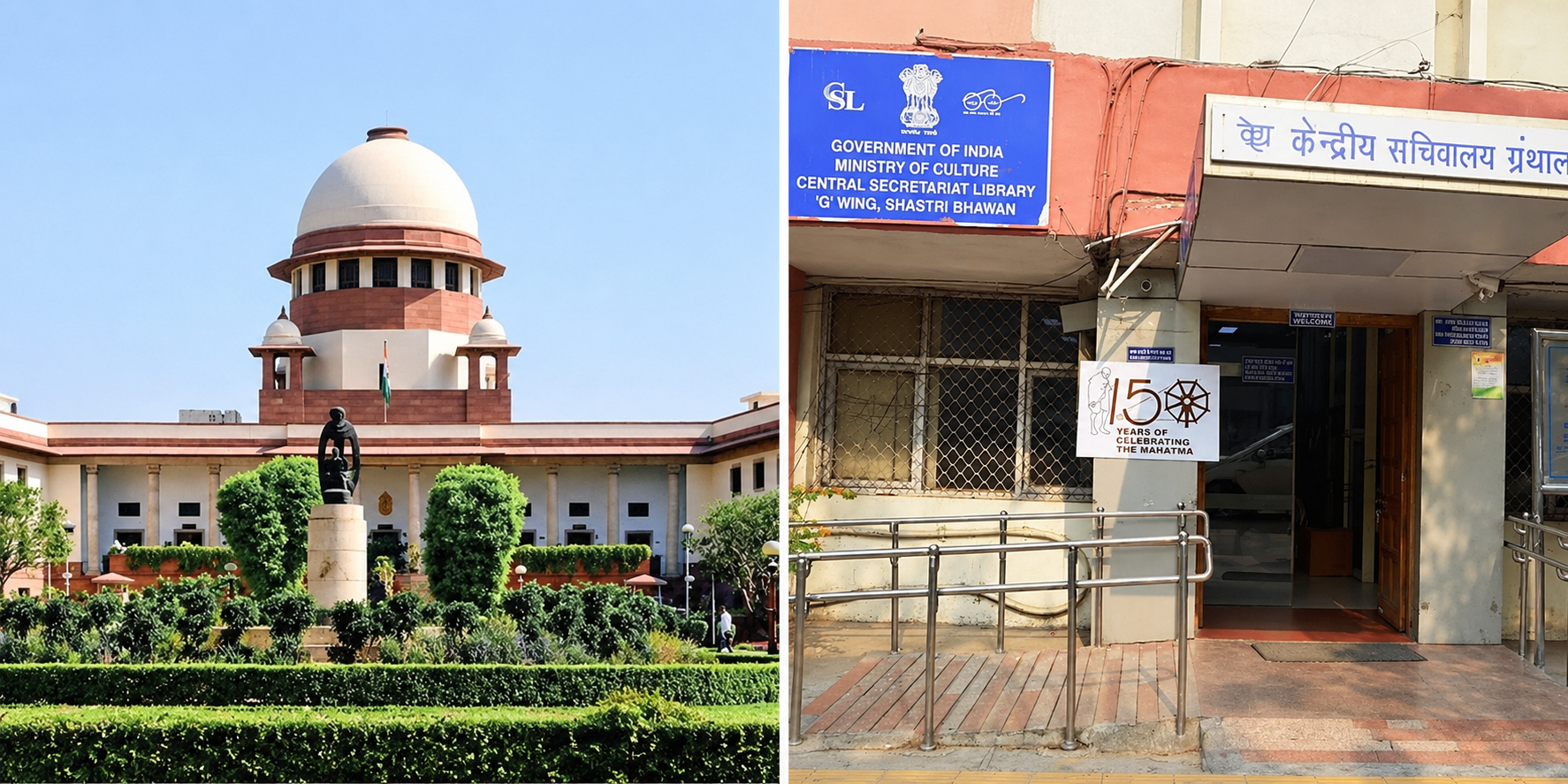
New Delhi: For more than a century, the Central Secretariat Library has quietly preserved the memory of India’s administration, politics, law, society and public life. With more than 8.5 lakh books and other documents, including rare publications, government records, gazetteers, parliamentary material and official documents, the 135-year-old institution is far more than a government library. It is a repository of India’s administrative memory.
Now, as Shastri Bhawan makes way for redevelopment under the Central Vista project, the future of the institution has come under the spotlight. The Supreme Court has taken suo motu cognisance of the issue, bringing the library’s relocation and future accommodation under judicial scrutiny.
The Court registered the matter on October 3 as “In Re: 135-Yr-Old Library 8.5 Lakh Books– And No Room In The New Central Vista Plan” (SMW(C) No. 21/2026). A Bench comprising Justices Sanjay Kumar and Sanjeev Sachdeva is scheduled to hear it on October 5.
The intervention follows reports about uncertainty over the library’s relocation as Shastri Bhawan is vacated for demolition. The Union Ministry of Housing and Urban Affairs (MoHUA), however, has clarified that the library has not been left without accommodation, saying space has been provided for it in the Kartavya Path redevelopment plan and construction is underway.
The issue, therefore, is not merely whether the library will have a new address, but whether an institution of this scale can be relocated without compromising its functioning, accessibility and preservation.
The story of the Central Secretariat Library goes back to 1891, when it was established in Calcutta as the Imperial Secretariat Library. Following the transfer of the capital to Delhi in 1911, it moved with the administration, first to the Old Secretariat Building in Civil Lines and later to North Block in the 1930s.
After Independence, it was renamed the Central Secretariat Library on April 1, 1948. In 1969, it moved to the newly constructed Shastri Bhawan, where it has remained for more than five decades. Its journey mirrors the evolution of India’s administrative capital - from colonial Calcutta to imperial Delhi and then to independent India.
Today, the library has approximately 8.5 lakh print and non-print documents and occupies four floors covering nearly 5,500 square metres.
Some rare material dates back centuries, with the oldest material in its rare-books section dating to 1702.
Notably, the question of appropriate space had been under discussion since 2023, when the Ministry of Culture sought approximately 5,466 square metres in the redeveloped Central Vista, equivalent to the library’s existing footprint. It also proposed a dedicated facility that would allow easy access for ministries and departments in the Central Vista.
On January 16, 2026, however, MoHUA informed the Culture Ministry that the competent authority had approved library space in two rooms on the ground floor of Kartavya Bhawan-02. The Culture Ministry subsequently expressed reservations, saying the proposed accommodation was inadequate for the library’s complete collection and facilities and that “complete relocation is not feasible.”
The issue became more urgent as Shastri Bhawan moved towards demolition. In September 2026, the CPWD asked ministries and departments housed in the complex to vacate the premises to facilitate construction work.
The question now is whether the proposed facility for the library will be adequate and capable of preserving the collection, and whether access to the library will remain uninterrupted during the transition.
The Court’s suo motu cognisance does not amount to a final determination on the relocation. But the intervention brings an institution that has largely operated away from the public spotlight into a significant national conversation.
BI Bureau