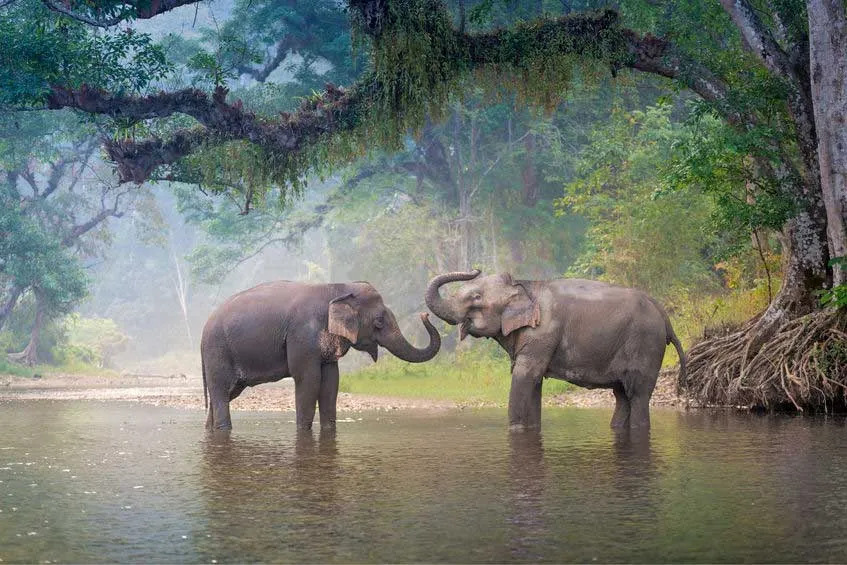
New Delhi: Every August 12, World Elephant Day offers India an opportunity to celebrate Gajaraj, an animal that has been part of the country’s ecological and cultural heritage for centuries. Revered in mythology and deeply woven into art, festivals and literature, the elephant also plays an important role in maintaining the health of forest ecosystems.
India is home to more than 60 per cent of the world’s wild Asian elephants, placing the country at the centre of global elephant conservation. Over the years, India has built a strong conservation framework around protecting elephant habitats, securing their movement corridors and improving scientific monitoring.
Today, the country has 33 Elephant Reserves across 14 States and 150 scientifically validated elephant corridors. Alongside these protected landscapes, population monitoring has become more advanced, while measures to mitigate human-elephant conflict continue to be strengthened.
Prime Minister Narendra Modi, marking World Elephant Day, highlighted this conservation journey and India’s special relationship with the species. In a post on X, he said:
“On World Elephant Day, we celebrate the majestic elephant which has remained an integral part of India’s ecological heritage. It is gladdening that India is home to over 60% of the world’s wild Asian elephants. Our nation has 33 Elephant Reserves, which provide habitats for elephants and strengthen our efforts towards their long-term conservation. We are also proud of all forest personnel, scientists, veterinarians, mahouts and the local communities who are integral to all such efforts.”
The Prime Minister’s message also brings attention to the many people working behind the scenes to protect elephants. From forest personnel and scientists to veterinarians, mahouts and local communities, elephant conservation is a collective effort.
Environment, Forest and Climate Change Minister Bhupender Yadav also reaffirmed India’s commitment to securing a shared future for elephants and people. On World Elephant Day, he pointed to 33 Elephant Reserves, 150 scientifically validated elephant corridors, advanced population monitoring and stronger measures to mitigate human-elephant conflict as important parts of the country’s conservation efforts.
“When we secure the future of elephants, we secure our forests, biodiversity and ecological heritage,” Yadav said, calling for efforts to ensure that the elephant continues to walk freely through India’s forests and landscapes for generations to come.
India’s conservation efforts are also increasingly supported by science. The latest national elephant assessment, released by the Wildlife Institute of India in 2025, estimated 22,446 elephants using a new DNA-based mark-recapture method. The figure cannot be directly compared with the earlier estimate of 29,964 as a simple decline because the methodologies were different. Instead, the latest assessment provides a new scientific baseline for understanding India’s elephant population.
The larger picture is equally important. Elephants require large, connected landscapes to move between feeding, watering and resting areas. This makes the protection of corridors an important part of conservation, alongside Elephant Reserves and scientific population monitoring.
India’s elephant story is therefore one of heritage, science and shared responsibility. On World Elephant Day, the focus is not only on the majestic animal itself, but also on the people, institutions, forests and landscapes that make its continued presence possible. Protecting the elephant means protecting a living part of India’s ecological heritage, and ensuring that Gajaraj continues to have a place in India’s future.
BI Bureau