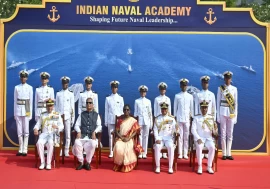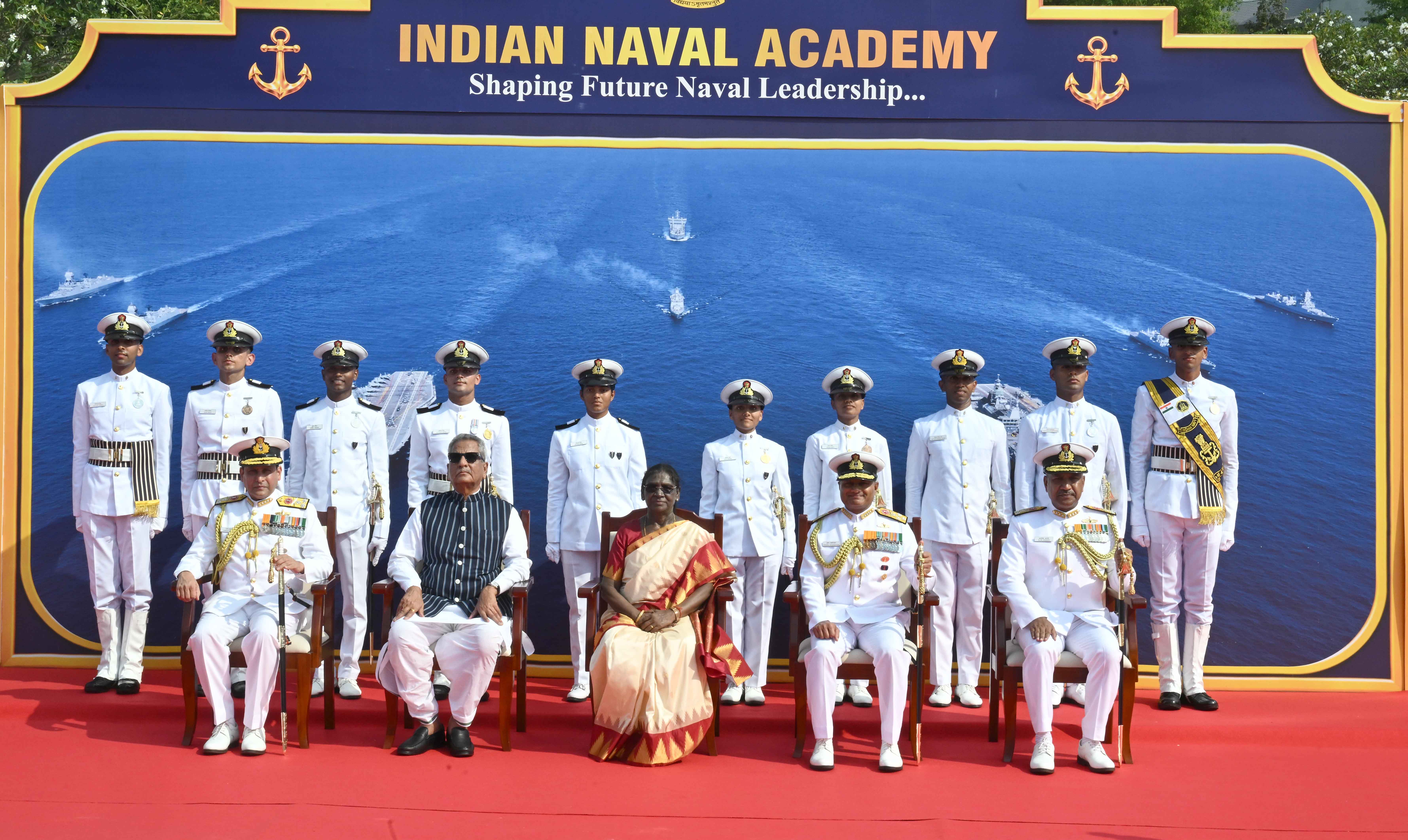
The President of India, Droupadi Murmu, reviewed the Passing Out Parade of Autumn Term 2026 at the Indian Naval Academy (INA), Ezhimala, Kerala, on November 28, 2026. She highlighted the growing importance of maritime security, the role of the Indian Navy in protecting global trade routes and the need for integrity, courage and professional competence among young naval officers.
The parade marked the successful completion of training by cadets, including trainees from the Indian Coast Guard and friendly foreign countries. The President also acknowledged the growing participation of women in the graduating batch, describing their achievements as an inspiration for more young women to take up challenging responsibilities in the service of the nation.
What is the Indian Naval Academy (INA)?
The Indian Naval Academy is the premier training institution of the Indian Navy, located at Ezhimala in Kannur district, Kerala.
It provides professional, academic and military training to officer cadets preparing for service in the Indian Navy.
Its key functions include:
- Providing initial training to officer cadets.
- Developing leadership and professional competence.
- Imparting naval knowledge and military skills.
- Preparing trainees to handle operational and maritime challenges.
- Training personnel from friendly foreign countries as part of defence cooperation.
The academy plays an important role in developing the next generation of naval officers.
Why is Maritime Security Important?
Maritime security refers to protecting seas, oceans, maritime trade routes and related infrastructure from threats that can disrupt navigation, commerce and national security.
A significant share of global trade moves through maritime routes. Any disruption can affect the movement of essential goods, increase transportation costs and put pressure on the economies of countries dependent on international trade.
Key aspects of maritime security include:
- Protection of commercial shipping routes.
- Prevention of piracy and armed robbery at sea.
- Combating smuggling and illegal maritime activities.
- Protection of ports and critical maritime infrastructure.
- Ensuring freedom of navigation.
- Responding to emerging maritime security threats.
President Droupadi Murmu emphasised that the security of maritime routes is directly connected to the economic well-being of nations and the everyday lives of their people.
What is the Role of the Indian Navy in Maritime Security?
The Indian Navy plays a central role in protecting India's maritime interests and maintaining security in the surrounding seas.
Its responsibilities include:
- Protecting India's maritime boundaries and interests.
- Safeguarding sea lines of communication.
- Conducting maritime surveillance and security operations.
- Supporting anti-piracy and anti-smuggling operations.
- Providing humanitarian assistance and disaster relief.
- Participating in international maritime cooperation and exercises.
The Navy's responsibilities extend beyond territorial waters, as developments in the wider Indian Ocean Region can also affect India's economic and strategic interests.
What are Sea Lines of Communication (SLOCs)?
Sea Lines of Communication, commonly known as SLOCs, are maritime routes used by commercial and naval vessels to transport goods, energy supplies, personnel and other resources.
These routes are important for international trade because a large volume of global cargo is transported through the oceans.
Their security is essential for:
- Maintaining uninterrupted international trade.
- Ensuring the movement of crude oil, natural gas and other essential commodities.
- Reducing disruptions in global supply chains.
- Supporting economic and strategic interests.
- Maintaining stability in important maritime regions.
The President's remarks highlighted how disruptions to shipping routes can eventually affect ordinary citizens through higher costs and shortages of essential goods.
What is the Significance of Women in the Armed Forces?
During the parade, President Murmu highlighted the presence and achievements of women among the graduating trainees.
She noted that their participation reflects determination, courage and professional competence, and can encourage more young women to take up challenging roles in national service.
Women's participation in the Armed Forces is significant for:
- Promoting equal opportunities in national service.
- Expanding the talent pool available to the Armed Forces.
- Strengthening institutional diversity.
- Encouraging greater representation of women in leadership roles.
- Inspiring future generations to pursue careers in defence services.
What Qualities Define Naval Leadership?
Addressing the graduating cadets, the President emphasised four important qualities: integrity, professional competence, courage and compassion.
She also highlighted that leadership is not limited to giving commands. It involves accepting responsibility, setting an example and standing by the personnel serving under one's command.
These qualities are particularly important in naval operations, where officers may face difficult weather conditions, long deployments and uncertain situations requiring decisions under pressure.
Why is this Important for UPSC?
The development connects with several important areas of the UPSC syllabus:
Internal Security: Maritime security, coastal security, piracy, smuggling and protection of critical infrastructure.
International Relations: India's maritime interests, Indian Ocean Region and cooperation with friendly foreign countries.
Indian Economy: Importance of maritime trade routes, global supply chains and the movement of essential commodities.
Defence and Security: Role of the Indian Navy, military training institutions and defence preparedness.
Governance and Society: Women's participation in the Armed Forces, equal opportunities and institutional leadership.
UPSC Prelims Facts
Indian Naval Academy
- Located at Ezhimala, Kerala.
- It is the premier training institution of the Indian Navy.
- Provides training to officer cadets.
- Also trains personnel from friendly foreign countries.
Maritime Security
- Concerns the protection of maritime routes, vessels and infrastructure.
- Is closely linked to international trade and economic stability.
- Includes efforts against piracy, smuggling and other maritime threats.
Sea Lines of Communication (SLOCs)
- Maritime routes used for the movement of goods, energy and personnel.
- Important for international commerce and strategic security.
- Their protection is essential for uninterrupted trade.
Possible UPSC Mains Question
Q. Maritime security is not merely a defence concern but also an important component of economic security and international trade. Discuss the significance of maritime security for India, particularly in the Indian Ocean Region.
Key points for an answer
- India's dependence on maritime routes makes their security important for trade and energy supplies.
- Disruptions to shipping routes can increase transportation costs and affect essential commodity supplies.
- The Indian Navy plays a key role in safeguarding maritime interests and sea lines of communication.
- Threats such as piracy, smuggling and other illegal maritime activities require continuous surveillance and international cooperation.
- Protection of ports and critical maritime infrastructure is essential for economic security.
- Cooperation with friendly countries strengthens regional maritime stability.
- India needs to enhance maritime domain awareness, naval preparedness and coastal security.
- Maritime security should be viewed as an integral part of India's economic, strategic and national security framework.
Main information source: Press Information Bureau (PIB), President of India, 28 November 2026.