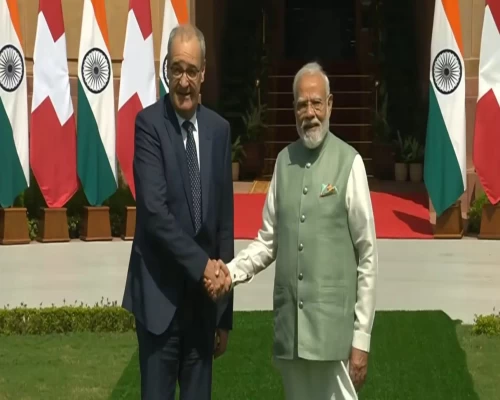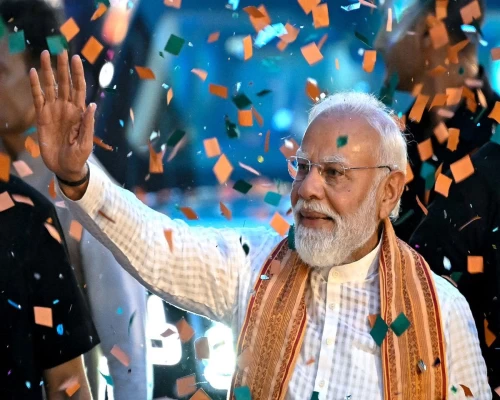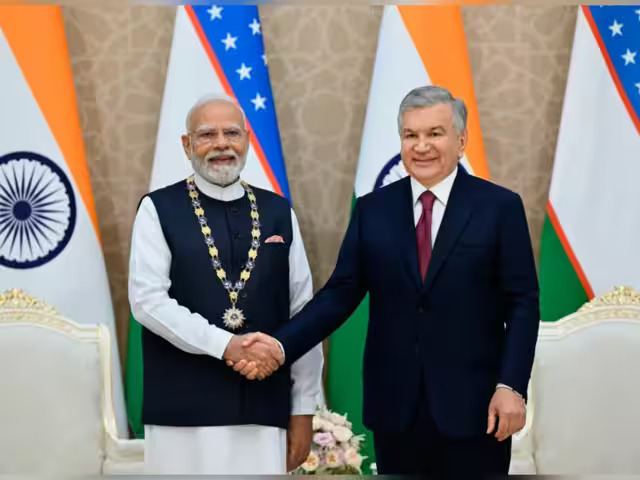
New Delhi: India and Uzbekistan have agreed to broaden their economic partnership, with the two countries identifying trade, investment, critical minerals, energy, digital technology and connectivity as key areas for closer cooperation during Prime Minister Narendra Modi’s state visit to Uzbekistan.
Modi and Uzbekistan President Shavkat Mirziyoyev held talks on August 29 and 30, reviewing the current state of bilateral ties and outlining areas for future cooperation. The two sides also reaffirmed their intention to elevate the relationship to a Comprehensive Strategic Partnership.
Trade and investment emerged as a major focus of the discussions. The two countries agreed to work towards diversifying bilateral trade, expanding the range of goods traded and addressing non-tariff barriers and investment hurdles. A Joint Working Group will be created to examine these issues, particularly in key sectors of bilateral trade.
The two sides also agreed to strengthen cooperation between Indian and Uzbek companies and improve connectivity between their value-added supply chains. Electrical items, engineering products, automobiles and pharmaceuticals were identified as sectors with significant potential for greater business-to-business cooperation.
Investment flows are also expected to receive greater institutional support. India and Uzbekistan will explore closer cooperation between Uzbekistan’s Investment Promotion Agency and Invest India, including through business forums, roadshows and investment seminars. The two countries also directed their relevant ministries to examine the next steps following the conclusion of a Joint Feasibility Study on an Uzbekistan-India Preferential Trade Agreement.
Critical minerals and energy have emerged as another area of potential expansion. The two countries agreed to explore cooperation in geology, mining, nuclear energy, industrial cooperation and critical and strategic minerals. This includes geological exploration, mining, processing, recycling and the development of integrated value chains.
The partnership is also set to extend into agriculture and food security, with both sides agreeing to develop agricultural value chains, improve export capabilities and promote resource-efficient technologies. They will also encourage cooperation between research institutions and enterprises to improve agricultural productivity and conserve plant genetic resources.
Connectivity remains an important part of the economic agenda. India and Uzbekistan will work on multimodal transport routes and logistics corridors, while continuing efforts to restore freight transportation and reduce transportation costs. Cooperation in road construction and the modernisation of public transport infrastructure is also being explored.
Technology cooperation is another growing component of the relationship. The leaders welcomed the expansion of partnerships between technology parks, companies, startups and educational institutions, building on the first IT Park in Tashkent, established in 2019 with support from the Software Technology Parks of India.
The two countries also agreed to strengthen cooperation on safe, secure and trustworthy artificial intelligence systems, including through exchanges of experience and best practices. They will also expand practical cooperation in space applications, scientific data and capacity-building.
Healthcare and pharmaceuticals are set to receive further attention, with both sides agreeing to expand cooperation in public health, biomedical research and medical innovation. The leaders highlighted the potential of the Tashkent Pharma Park Innovative Scientific and Industrial Pharmaceutical Cluster to support joint projects, investment, technology transfer and local manufacturing.
The two countries also announced cooperation to green and ecologically rehabilitate the Aral Sea region. The effort, valued at US $1 million, will include technical support from India under its Grant-in-Aid framework.
The broader engagement will also cover education, culture, sports and traditional medicine. More than 2,700 Uzbek nationals have participated in India’s ITEC programme, while over 400 Uzbek students have received ICCR scholarships. The leaders also welcomed cooperation between the Yoga Federation of Uzbekistan and India’s Ministry of AYUSH, along with the conclusion of an MoU on traditional medicines.
The discussions also covered regional and international cooperation, including coordination through the Shanghai Cooperation Organisation, the United Nations and other multilateral platforms. Uzbekistan reaffirmed its support for India’s candidature for permanent membership of the UN Security Council, while India conveyed its readiness to support Uzbekistan during its forthcoming chairship of the Non-Aligned Movement from 2027 to 2030.
BI Bureau